Visa Photo Requirements: US, UK, Schengen and Gulf Compared
Compare visa photo rules for the US, UK, Schengen states, the UAE and Saudi Arabia: print sizes, digital file limits, glasses, head coverings, babies and common rejections.
In this guide · jump to a section
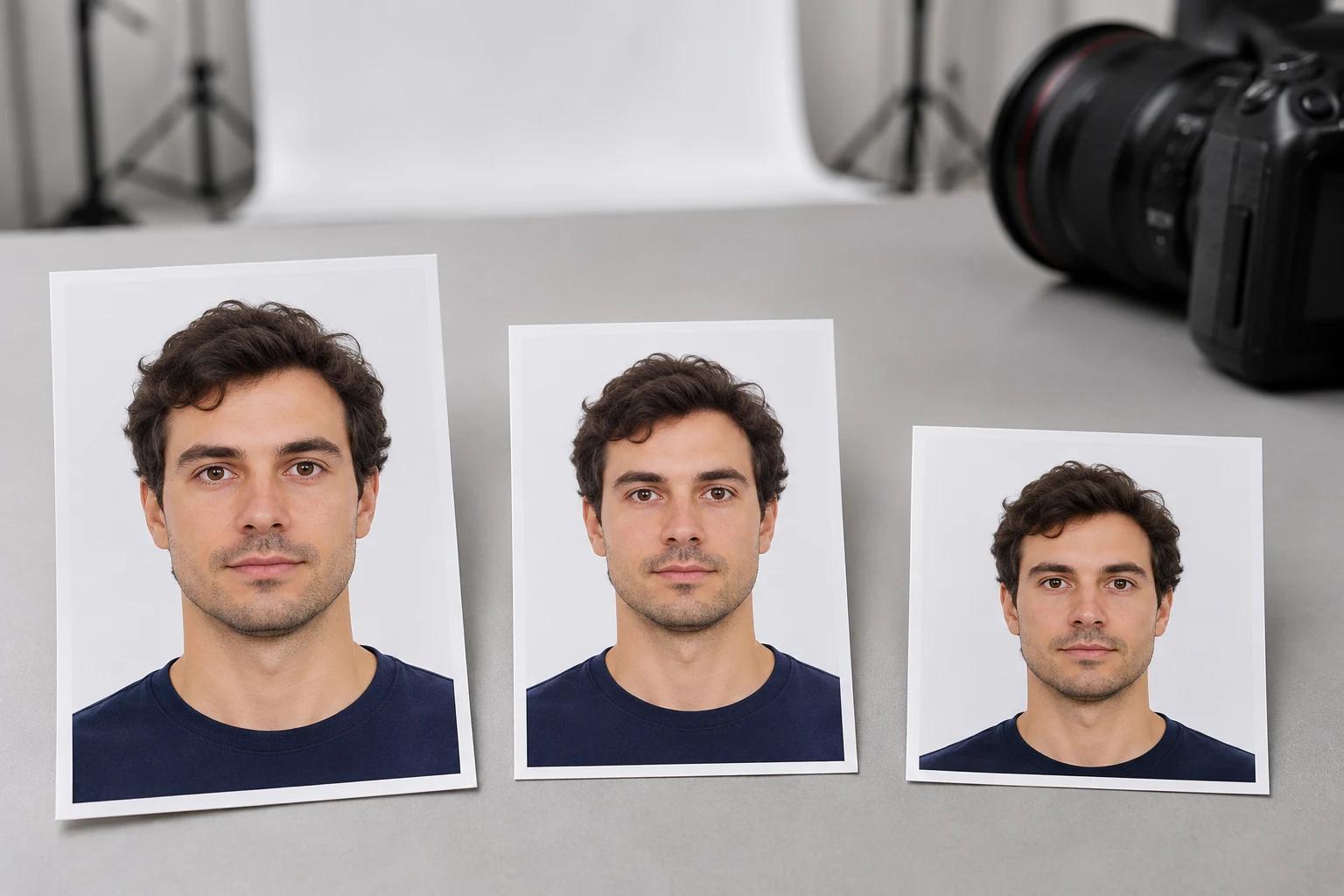
Each country sets its own visa photo rules, so a picture accepted for one application can be rejected for another. As of November 2026, the United States asks for a square photo (2 x 2 inches in print, 600 to 1,200 pixels as an upload) with no glasses, the UK wants a portrait-shaped digital file of at least 600 x 750 pixels, Schengen states apply the ICAO standard (German missions ask for a 35 x 45 mm print), and the UAE and Saudi Arabia require a white background. Everywhere, the photo must be recent, unedited and a true likeness.
At a glance
| Destination | Size or file | Key rules |
|---|---|---|
| United States | Print 2 x 2 in (51 x 51 mm); upload JPEG, square, 600 to 1,200 px, max 240 kB | No glasses; within 6 months; head 50 to 69% of image height |
| United Kingdom | Upload JPG, at least 600 x 750 px, 50 KB to 6 MB | Plain light background; no filters; no photo of a photo |
| Schengen (Germany) | Print 35 x 45 mm; face 32 to 36 mm | ICAO standard; light background; max 6 months old |
| Schengen (France) | Width 35 to 40 mm; face 32 to 36 mm | ICAO standard |
| UAE (ICP) | 3.5 x 4.5 cm | White background; no hats or sunglasses |
| Saudi eVisa | Upload; page lists 200 x 200 px, 5 to 100 KB | White background; max 6 months old |
| Qatar (Hayya) | No public visitor specification found | Follow the portal's instructions |
Who these rules apply to
This guide covers visa and eVisa applications, not passports, whose photo standards are related but separate. If you apply in person, your photo may be taken or checked at the visa centre. In the UK, an uploaded photo that falls short can lead to a request to attend an enrolment centre instead.
Country-by-country rules
United States
The State Department's visa photo page requires a photo taken within the last six months. Glasses are no longer allowed, except where they cannot be removed for medical reasons, in which case you need a signed medical statement. The image must not be digitally enhanced or altered.
For online applications, the digital image requirements are a square JPEG between 600 x 600 and 1,200 x 1,200 pixels, no larger than 240 kB, in sRGB colour, with your head filling 50 to 69 per cent of the image height. The Diversity Visa lottery asks for exactly 600 x 600 pixels. Immigrant visa applicants using Form DS-260 bring two identical 2 x 2 inch prints to the interview.
United Kingdom
GOV.UK asks for a JPG or JPEG at least 600 pixels wide and 750 tall, between 50 KB and 6 MB, in portrait orientation. It should show your head, shoulders and upper body against a plain, light background, with no other people or objects. Filters, editing and mirrored images are not accepted, and neither is a photo of an existing photo, such as the one in your passport. Avoid glasses where possible; sunglasses and tinted lenses are not allowed. You can use the UK Immigration: ID Check app or upload through the online form. Our UK Standard Visitor guide covers the rest of the application.
Schengen countries
The common Schengen application form requires photos that meet ICAO Document 9303. The European Commission's photo guidelines add that the picture must be no more than six months old, sharply focused and taken against a plain light background with even lighting. German missions ask for 35 x 45 mm photos in which the face, chin to hairline, fills 70 to 80 per cent of the height (32 to 36 mm), with a light background, ideally neutral grey, and no heavy make-up or coloured contact lenses. France-Visas gives a width of 35 to 40 mm with the same face height. Germany's federal printing office publishes a photo template for checking face size and eye position. The number of photos depends on the mission; see our German Schengen application guide.
Gulf eVisas: UAE, Saudi Arabia and Qatar
The UAE's Federal Authority for Identity, Citizenship, Customs and Port Security (ICP) lists a recent colour photo with a white background among its general visa documents, and its service guide gives a size of 3.5 x 4.5 cm with ICAO compliance. Hats and sunglasses are not allowed, and medical glasses are acceptable only if they do not cover the eyes. One ICP specification sheet says light-coloured rather than white, so white is the safer choice.
The Saudi eVisa specifications call for a white, unpatterned background without shadows, only you in the frame, a centred face looking straight ahead, and a photo no more than six months old. The page lists 200 x 200 pixels and 5 to 100 KB. Our Saudi tourist eVisa guide explains the wider process.
For Qatar, the hayya.qa pages reviewed for this guide set out no public photo specification for visitors, so follow the portal's on-screen instructions and use an ICAO-style photo.
How to get a compliant visa photo
- Confirm the destination, visa type, and whether you upload a file or bring prints.
- Note the size, file limits and background colour from the official photo page.
- Take a new photo facing the camera, with a neutral expression, mouth closed and eyes open.
- Light your face evenly from the front so nothing casts a shadow.
- Crop to the required shape without filters or background replacement.
- Check file type, pixel dimensions and file size before uploading.
Photo checklist before you submit
- Taken within the last six months, or new for the UK
- Square for the US, portrait for the UK and Schengen
- Plain background in the required colour
- Full face visible, centred and not tilted
- No shadows, glare or red-eye
- No other people, hands or objects in the frame
Cost and timing
The cost is whatever a studio charges, or nothing if you take a compliant photo yourself for an online upload. Timing matters more: most of these authorities set a six-month limit, so a photo from an earlier application may already be too old.
Common rejection reasons
- An old photo reused from a previous application
- Glasses in a US photo, or tinted lenses anywhere
- Smoothing, beauty filters or a replaced background
- The wrong shape or a file outside the upload limits
- A photo of a print or of your passport page
- A face too small or too large in the frame
Head coverings for religious reasons
The US accepts a head covering only when it is worn daily for religious reasons, and it must not hide any part of your face or cast a shadow on it. The UK allows head coverings for religious or medical reasons. The ICP documents reviewed ban hats without setting out a separate religious rule, so confirm with ICP or your sponsor first. Schengen photos follow the ICAO standard, which requires the whole face to be visible.
Babies and children
Children need a photo that meets the same basic standard, though some authorities relax it for the very young. German missions do not check photos of children up to five years old for biometric suitability. Saudi Arabia allows no other person in the photo, so a parent's hands or lap must not appear. A practical approach is to lay a baby on a plain, light sheet and photograph from directly above.
Frequently asked questions
Can I take my visa photo on a phone?
For online applications, usually yes, if the file meets the size and quality rules. The UK explicitly supports self-taken photos. A second person or a tripod keeps the camera at eye level and avoids a mirrored selfie.
Can I wear glasses?
Not in a US visa photo unless a medical reason prevents removal and you have a signed statement. The UK asks you to avoid them and bans tinted lenses; the UAE accepts medical glasses only if they do not cover your eyes.
Can I use one photo for every application?
Only if it meets each format. A square US file will not suit the UK's portrait format, and the white background required in the Gulf differs from the grey German missions prefer.
Can I reuse my passport photo?
Not as a photo of the printed page. A digital original from the same session may work if it is within the age limit and matches the format.
Photo rules change, and embassies and visa centres can add their own instructions. Before you pay for an application, check your file against the photo guidance on the official portal you are applying through, and be wary of paid photo-approval services that present themselves as official; our guide to spotting fake visa websites explains the warning signs.
Sources and verification
- U.S. Department of State: Photo Requirements (visas)travel.state.govSeparate source-check date not recorded
- U.S. Department of State: Digital Image Requirementstravel.state.govSeparate source-check date not recorded
- GOV.UK: Take a photo of your face for a visa application or permissiongov.ukSeparate source-check date not recorded
- European Commission: ICAO photograph guidelines (visa applications)home-affairs.ec.europa.euSeparate source-check date not recorded
- France-Visas: Frequently asked questionsfrance-visas.gouv.frSeparate source-check date not recorded
- Bundesdruckerei: Lichtbild-Schablone (photo template, adults)bundesdruckerei.deSeparate source-check date not recorded
- UAE ICP: Personal Photo Specificationsicp.gov.aeSeparate source-check date not recorded
- Saudi eVisa: Photo Specificationsvisa.visitsaudi.comSeparate source-check date not recorded
These are the sources cited for this article. Last article update: 2 Nov 2026. Requirements can change and depend on your nationality and circumstances. This article is general information, not a personal eligibility assessment.
Independent, AI-assisted guidance.Read moreRead less
Use this guide to prepare, then confirm the rules with the responsible authority.
- Last verified against all cited sources
- Not recorded
- Named immigration-expert review
- Not recorded · Who produces this guide
An article update date is not a source-verification date. A source check is not a guarantee of eligibility or future accuracy.
Recorded correction: Replaced an unrelated airport-shop cover with an explicitly credited AI-generated illustration of visa-photo prints. This corrected the illustration; it did not re-verify the visa rules. View dated correction