UAE Pet Travel: Why Official Pages Show Different Import-Permit Deadlines
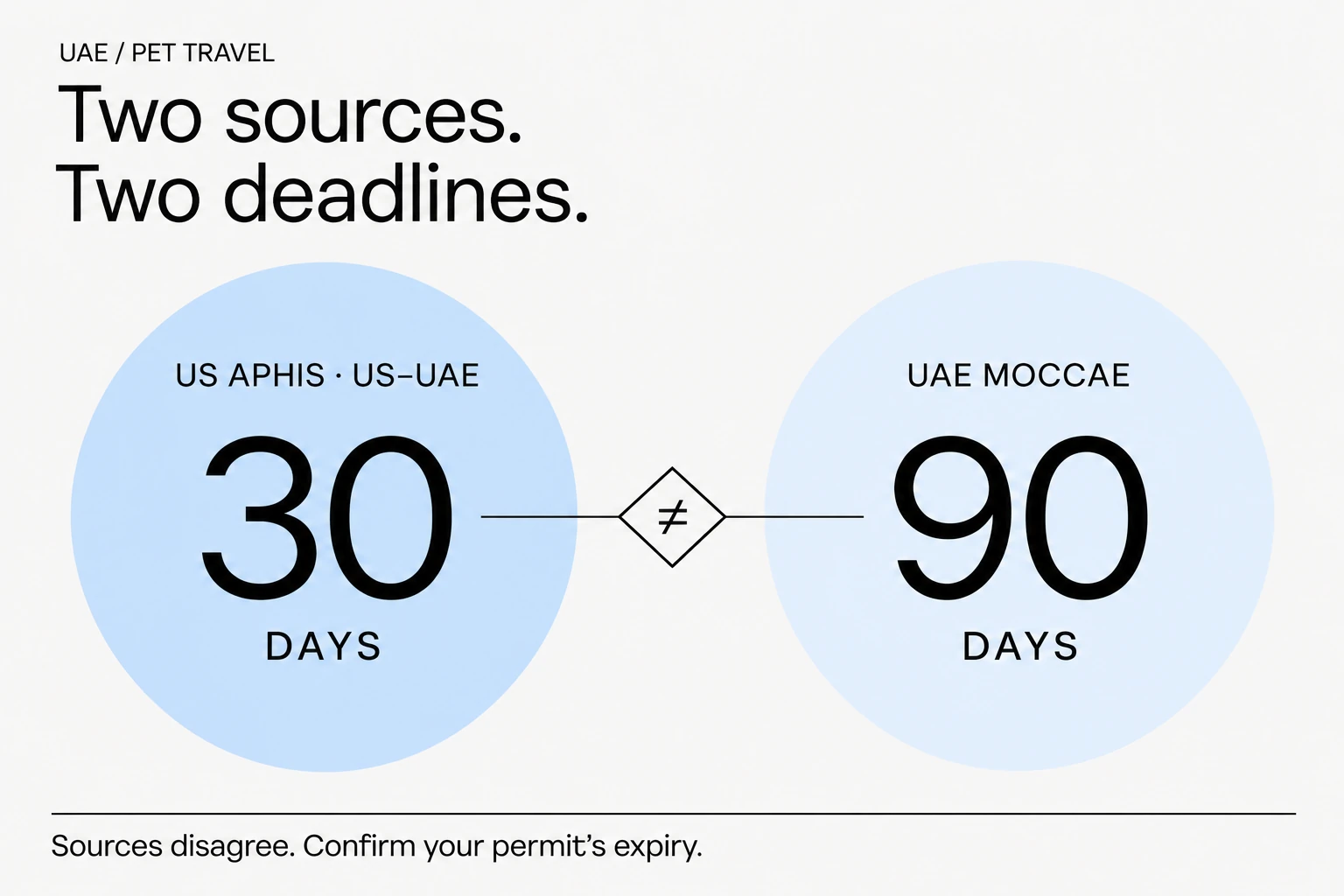
MOCCAE’s service description says 90 days; US APHIS guidance for travel to the UAE says 30. Our source comparison explains the unresolved mismatch and the questions to settle before booking.
In this guide · jump to a section
Official-source checking sometimes produces a conflict rather than a clean answer. For pet travel to the UAE, the Ministry of Climate Change and Environment's service description says an import permit is valid for 90 days. The US Department of Agriculture's APHIS page for pets travelling from the United States to the UAE says 30 days.
We compared these pages on 15 November 2026. The APHIS page is marked as modified on 27 October 2026. We have not obtained a written explanation from either authority, so this article does not declare one deadline universally correct or claim to have discovered when a rule changed.
The difference is visible in the source wording
| Official source | Published import-permit wording | Scope to remember |
|---|---|---|
| MOCCAE service description | Valid for 90 days from issuance | UAE pet-import service |
| MOCCAE Arabic service page | 90-day validity; expired permits cannot be used | UAE service requirements |
| USDA APHIS route page | Valid for 30 days | Pets travelling from the United States to the UAE |
The two UAE pages agree on the period. That does not explain why the US route page gives a different number. A page's recent modification date is also not proof that every sentence was newly verified on that date.
The responsible next step is to reconcile the issued permit, current UAE instructions and the export authority's requirements for the actual journey. Do not select the longer period simply because it is more convenient for a booking.
There is more than one clock
APHIS separately describes a health certificate valid for ten days after issuance on its US-to-UAE route page. That is not the same document as the UAE import permit. Confusing the two could leave a traveller with one valid document and another that no longer fits the departure or arrival plan.
Our suggested timeline has separate rows for import permission, veterinary certification, required health preparation and transport arrangements. Record the relevant date and issuing authority on each row. A single reminder called “pet paperwork expires” hides differences that can matter when a flight moves.
Because the APHIS instructions concern export from the US, do not apply its certification workflow automatically to a pet leaving another country. Find that country's competent veterinary authority and the carrier's current requirements. Species, origin, health history and route can all affect the checks needed.
Ask a question that can resolve the mismatch
Here is an original enquiry template to adapt privately: “I plan to bring a [cat/dog] from [country] to [UAE entry point] on [date]. My issued permit states [expiry date]. The MOCCAE service page states 90 days, while the US APHIS route page states 30. Which validity and supporting-document deadlines apply to this journey, and do I need a replacement permit?”
Send the relevant details through the authorities' official channels. Do not publish permit numbers, personal addresses or veterinary records in a public comment. Retain the answer with the issued documents so a later itinerary change can be checked against the same explanation.
Before making a non-refundable commitment
Confirm the permit's actual expiry, the health-certificate timing and the carrier's acceptance of the animal and route. An import permit is not an airline booking, and an airline reservation is not a substitute for regulatory permission.
This comparison is original desk research: we identified a documented discrepancy and explained its planning consequences. It is not an embassy interview, veterinary advice or a clearance decision. Use our official-source directory for the wider travel file and the primary links below for the pet-specific enquiry. We will need new evidence before describing this conflict as resolved.
Sources and verification
- UAE MOCCAE: import of pets service descriptionmoccae.gov.aeRecorded substantive check: 17 Nov 2026
The MOCCAE service description continues to state that a cat or dog import permit is valid for 90 days from issuance. It separately describes inspection and release at the entry port and lists the import-permit and release fees.
- USDA APHIS: pet travel from the US to the UAEaphis.usda.govRecorded substantive check: 17 Nov 2026
The APHIS route page, last modified 27 October 2026, still states that the UAE import permit is valid for 30 days. Its scope is pets travelling from the United States to the UAE, so the statement is not treated as a universal UAE rule.
- UAE MOCCAE: current Arabic pet-import servicemoccae.gov.aeRecorded substantive check: 17 Nov 2026
The current Arabic MOCCAE service page still states 90-day permit validity, requires a valid permit at entry, and lists animal-health and personal-import conditions. It does not explain the conflicting 30-day wording on the APHIS route page.
These are the sources cited for this article. Last article update: 15 Nov 2026. Requirements can change and depend on your nationality and circumstances. This article is general information, not a personal eligibility assessment.
Independent, AI-assisted guidance.Read moreRead less
Use this guide to prepare, then confirm the rules with the responsible authority.
- Last verified against all cited sources
- · Automated source check by Advise Visa AI-assisted source review
- Named immigration-expert review
- Not recorded · Who produces this guide
An article update date is not a source-verification date. A source check is not a guarantee of eligibility or future accuracy.
What this guide adds: A fresh maintenance comparison confirms that both UAE MOCCAE sources still state 90 days while the current US-to-UAE APHIS route page still states 30 days. The guide continues to present the conflict as unresolved and keeps the two documents separate. Our original explainers