Bringing Medicine to the UAE: A Travel Bag and a Courier Parcel Follow Different Routes
The Emirates Drug Establishment separates travellers carrying medicine from residents importing it through shipping companies. Check the route, ingredient and supporting documents before packing or sending.
In this guide · jump to a section
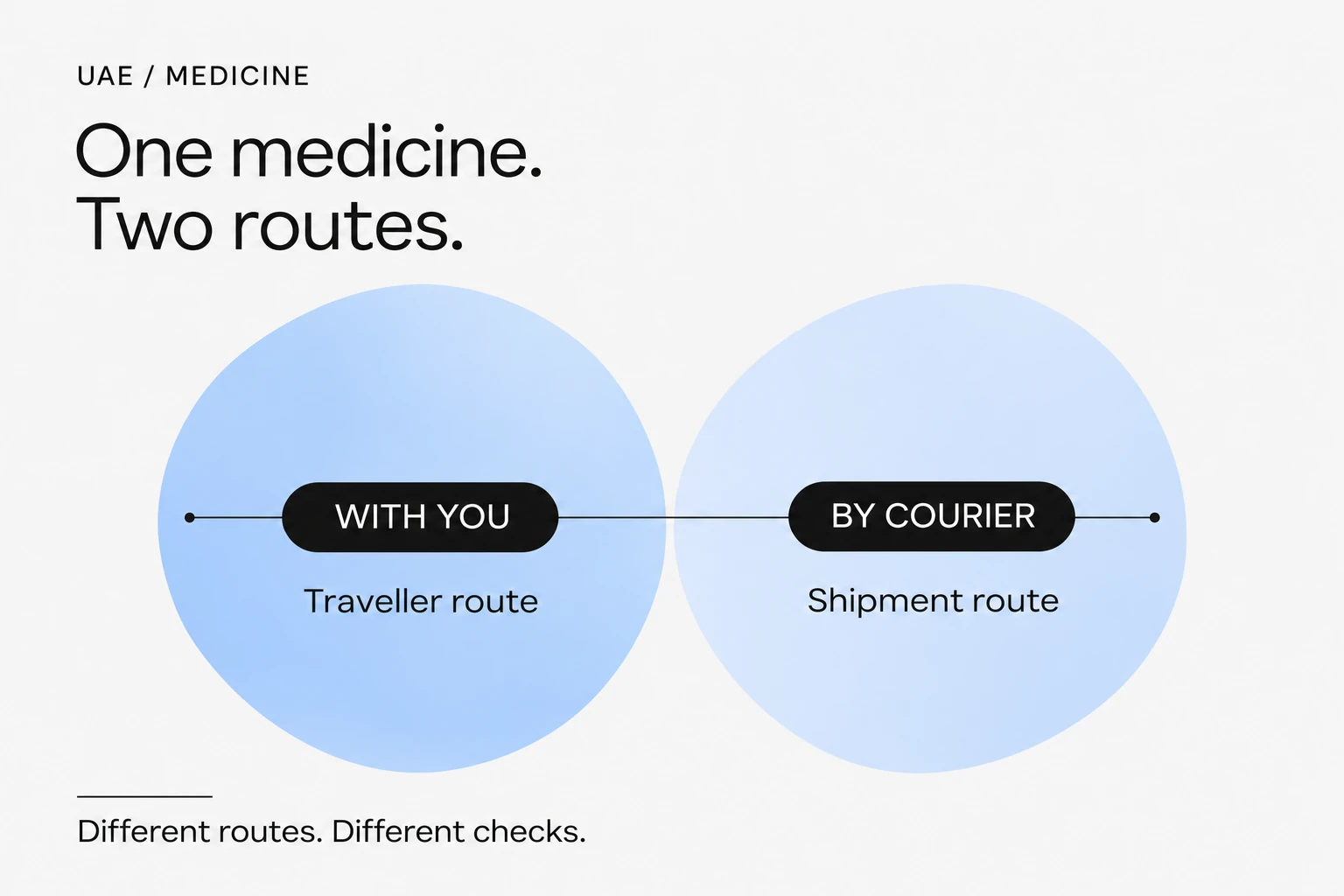
“Can I bring this medicine to Dubai?” is missing an important detail: will the patient carry it, or will a shipping company deliver it? The Emirates Drug Establishment's service page describes these as different situations. Advice written for an accompanied suitcase should not be reused automatically for a courier parcel.
There is another necessary distinction: the active ingredient and its UAE classification matter. A familiar brand name, a prescription issued abroad or a small package does not by itself answer the import question. This is travel-document guidance, not advice to start, stop or change a treatment.
Choose the correct delivery route first
| Situation | Starting point | Mistake to avoid |
|---|---|---|
| Traveller carrying personal medicine | EDE traveller requirements and ingredient classification | Assuming optional advance approval means no conditions |
| UAE resident arranging a shipment | EDE electronic import approval for the shipping route | Treating a parcel as accompanied passenger baggage |
| Unclear product or quantity | A specific enquiry with ingredient, strength and quantity | Asking only whether a brand is allowed |
EDE describes advance approval for travellers carrying controlled medicines as optional, with a maximum three-month supply for the controlled-medicine route. Its resident shipping pathway requires electronic approval. The supporting prescription and medical-report requirements must also be checked against the current service instructions.
MOHAP's published traveller guidance supplies a detail that “optional” can conceal: where advance approval was not obtained, controlled medicines must be declared on arrival with the required prescription and medical report. Do not read the absence of an advance application as permission to pass through without disclosure or records.
Assemble a product record, not just a photograph
For each medicine, make a short record of the patient, active ingredient, strength, form, total quantity and prescribed use. Keep the actual prescription and relevant clinical documentation with that record. The point is to make the regulatory enquiry intelligible; a photograph of the front of a box may omit the ingredient or quantity being assessed.
EDE specifies recency and authentication requirements for medical documents, including a prescription issued within three months and a medical report within one year. Read the service page for the required particulars and endorsements. A document can be recent yet still lack the details needed to identify the patient or medicine.
When a changed plan changes the paperwork
Consider a fictional traveller who first intends to carry medicine personally, then decides to have a relative send the same boxes after arrival. The product has not changed, but the delivery route has. Our practical recommendation is to stop and recheck the shipping pathway before dispatch, rather than attach a printout about traveller baggage to the parcel.
A useful enquiry would state: “I am a UAE resident; this medicine will arrive through a shipping company; here are its ingredients and quantity. Which approval and documents apply?” That is more actionable than “I have a prescription, so can my family send it?” Do not include sensitive medical records in a public comment or an unrelated website contact form.
Keep permission, transport and treatment separate
An import service does not replace a clinician's judgment about treatment, and a courier's willingness to accept a parcel does not establish regulatory permission. Resolve both questions through the appropriate channels before sending anything.
We compared official online instructions for this article; we did not obtain an individual clearance or speak to an embassy. Use the EDE service linked below for current requirements, and keep a copy of any answer relevant to your exact product and route. Our application checklist can help organise records, but it cannot classify a medicine.
Sources and verification
- Emirates Drug Establishment: personal-use medicine import permitede.gov.aeRecorded substantive check: 15 Nov 2026
The current service distinguishes optional advance approval for travellers carrying controlled medicine from electronic approval for residents importing through shipping companies. It describes prescription and medical-report documentation and a maximum three-month controlled-medicine supply.
- MOHAP: personal-use medicine service guidancemohap.gov.aeRecorded substantive check: 15 Nov 2026
The ministry service document says travellers without prior approval must declare controlled medicines on arrival with the required prescription and medical report. It supports the distinction between optional advance approval and having no documentation obligations.
These are the sources cited for this article. Last article update: 15 Nov 2026. Requirements can change and depend on your nationality and circumstances. This article is general information, not a personal eligibility assessment.
Independent, AI-assisted guidance.Read moreRead less
Use this guide to prepare, then confirm the rules with the responsible authority.
- Last verified against all cited sources
- · Automated source check by Advise Visa AI-assisted source review
- Named immigration-expert review
- Not recorded · Who produces this guide
An article update date is not a source-verification date. A source check is not a guarantee of eligibility or future accuracy.
What this guide adds: An original traveller-versus-courier decision worksheet and hypothetical changed-plan example separate different import pathways and identify the evidence to check without giving treatment advice. Our original explainers