Australia Announces New Second and Third Working Holiday Registration: Key 2027 Dates
Australia’s new second and third Working Holiday process opens in December. Check the February transition deadline, March work changes and UK exemption.
In this guide · jump to a section
Australia has announced a new registration and invitation process for people seeking a second or third Working Holiday Maker visa. The key planning issue is the transition between the current application route and the rules scheduled for March 2027.
This is a guide to an announced change, checked on 26 November 2026. The registration opening and the mandatory application rules are future dates at the time of writing. Applicants should return to the official guidance before registering or lodging, especially if their work plan runs close to a deadline.
The announced timetable
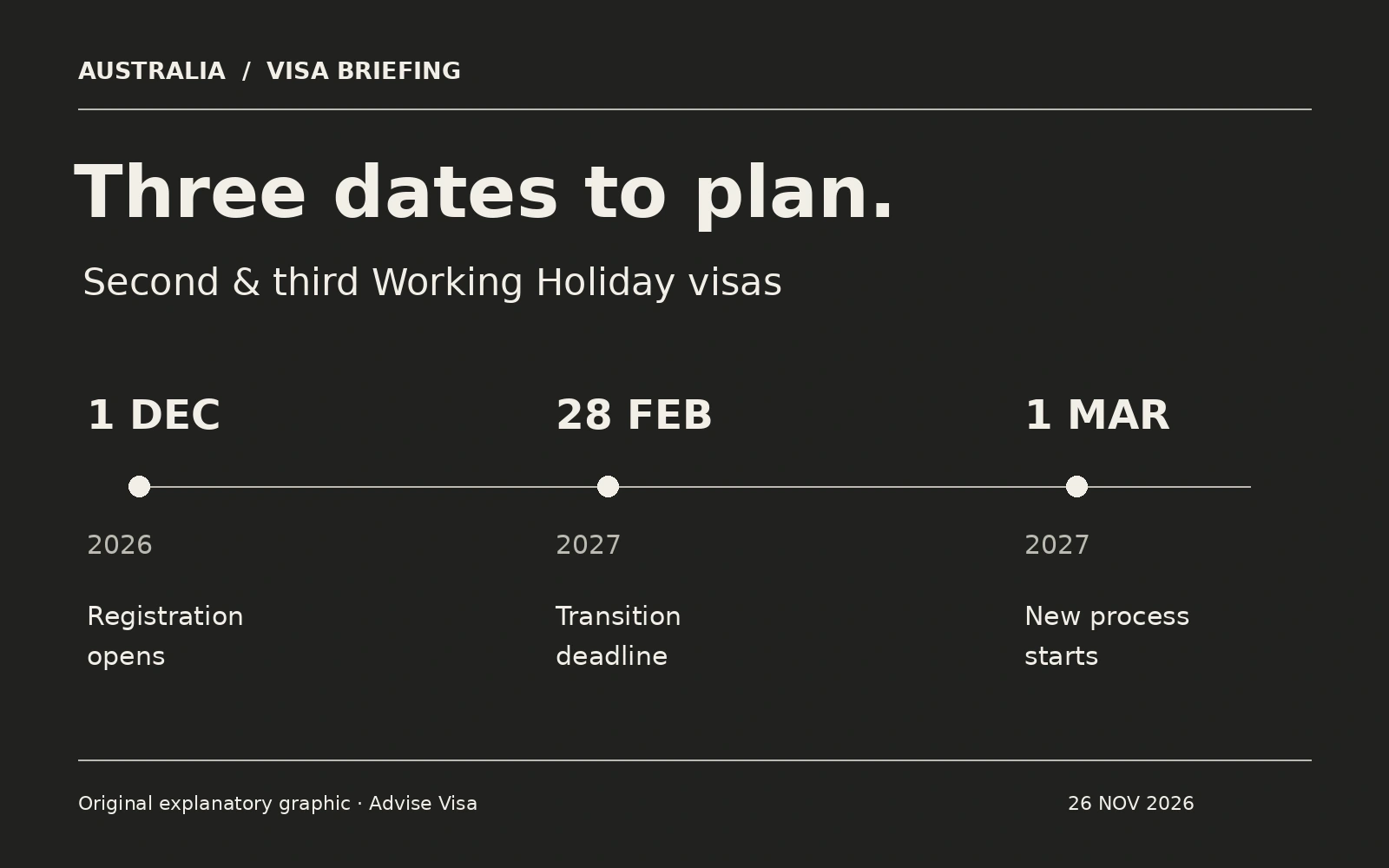
The Home Affairs announcement of 17 November says registration opens 1 December 2026 for second and third subclass 417 and 462 visas. From 1 March 2027, applicants covered by the change must register, be selected and complete the required specified work before applying.
A valid application lodged by 28 February 2027, with the required work completed and other requirements met, can use the transition. UK passport holders are exempt from the new registration and invitation process. From March, the second-visa work requirement rises from 88 to 120 days; eligible previous work counts, while the third-visa requirement is unchanged.
The first invitation round is expected in mid-January, not guaranteed for that date. Registration can occur before work is complete and from inside or outside Australia. Selected applicants have 12 months to apply if eligible. Registration does not guarantee selection; invitation does not grant a visa or extend an existing stay.
The official transition diagram adds an annual registration detail: registrations last until 30 June, and participation in later rounds requires registration again from 1 July. Keep that renewal separate from the expiry of your current visa and any invitation. A registration reminder does not preserve permission to remain in Australia.
Decide which question you need to answer
Applicants often begin with “How many days do I have left?” A better first question is “Which application timetable can I realistically meet?” Work completion, evidence preparation and valid lodgement are different tasks. A promising work roster alone does not establish that an application will be ready.
Make a timeline with your current visa expiry, expected last workday and intended submission date. Add a separate line for missing documents. This is a planning tool, not a legal calculation: its purpose is to reveal whether your plan depends on everything going perfectly.
For example, imagine an applicant whose eligible work is expected to finish in early February. They should still check whether the evidence will be available promptly and whether every other application requirement can be met. Someone expecting to finish in late March needs to assess the later process instead of assuming a February intention to apply preserves the earlier route.
Check whether your work actually qualifies
The department’s specified-work guidance ties eligibility to the industry, location and circumstances of the work. Under the current framework, the second-visa minimum is equivalent to 88 calendar days and the third to 179, with full-time-equivalent counting rules. Simply being employed somewhere rural is not a complete eligibility test.
Longer shifts cannot turn one calendar day into two qualifying days. Part-time patterns may require a longer overall period, and unpaid days lost to weather do not automatically count. The page also explains eligible rest-day arrangements and the limited circumstances where voluntary disaster-recovery work qualifies.
Before accepting a job mainly for immigration purposes, write down the employer, actual duties, worksite postcode, expected roster and pay arrangement. Compare those details with the official rules for your subclass. A job advertisement saying “visa days available” is not a substitute for that comparison.
Build evidence while you are working
The second subclass 417 application guidance identifies evidence such as payslips, Australian bank statements, employer references and relevant piece-rate agreements. Proof should cover the claimed work periods. The department may contact employers to check claims.
Its document guidance also covers identity and financial evidence. Applicants should use the checklist applicable to their location and circumstances, rather than assuming another traveller’s document bundle is complete for them. For subclass 462, use that subclass’s own application guidance rather than copying a 417 checklist wholesale.
A practical work log can contain the date, site, duties, hours, employer and matching payslip filename. Reconcile the log with payment records regularly. Where names or dates differ, ask for a clarification while the records are easy to retrieve. Waiting until the last week before submission makes small discrepancies harder to investigate.
Keep the underlying documents, not just your own spreadsheet. A spreadsheet is useful for organising evidence; it does not transform an unsupported entry into proof of qualifying employment.
Allow room for ordinary disruptions
An original planning example helps illustrate the problem. A traveller expects a harvest role to provide a steady roster, but the employer reduces shifts for two weeks. Their calendar still shows the same arrival and departure dates, while the actual work pattern has changed. The sensible response is to recalculate against the official counting guidance and update the application plan.
Build a buffer around document collection and work completion. Ask when final payslips and references are normally issued. Keep a contact route for the employer after leaving the area. Save copies somewhere accessible if you change accommodation or replace your phone.
Avoid using a registration or anticipated invitation as a financial guarantee. Accommodation, onward travel and employment decisions should have a fallback if the next application cannot proceed when hoped. A plan is stronger when it identifies both the preferred route and what you will do if that route is unavailable.
Keep first-year and later-year processes separate
This announcement concerns second and third visas. Readers comparing passport eligibility and first-year ballot arrangements can use our separate Working Holiday passport and ballot guide. Do not carry a rule from one stage into another without checking its scope.
For your next review, gather three things: the current official announcement, the application guidance for your subclass and your own dated work evidence. Mark what is already established and what remains an assumption. That small distinction is especially valuable during a transition, when older guidance and future changes can appear together in search results.
The immediate task is preparation: verify the work, organise the records and understand which timetable fits the facts. Recheck the department’s instructions as the opening and commencement dates arrive before making a submission.
Sources and verification
- Home Affairs: Working Holiday changesimmi.homeaffairs.gov.auRecorded substantive check: 26 Nov 2026
Announced17November2026:registration1December,mandatory1March2027; validapplicationsby28Februarytransition;120days secondvisa,UKexemption,expectedmidJanuaryinvitations.
- Home Affairs: Second subclass417immi.homeaffairs.gov.auRecorded substantive check: 26 Nov 2026
Current specified-work evidence includes payslips bankstatements employerreferences; identity and financial evidence requirements.
- Home Affairs: Specified work417immi.homeaffairs.gov.auRecorded substantive check: 26 Nov 2026
Eligibleindustry/location and workcounting; current88days second179third; overtime cannot doublecount a day; unpaidweatherinterruptions do notcount.
- Home Affairs: Working Holiday transition diagramimmi.homeaffairs.gov.auRecorded substantive check: 26 Nov 2026
Official transition timeline, UK exemption, invitation and lawful-stay distinction, annual registration expiry on 30 June and re-registration from 1 July.
These are the sources cited for this article. Last article update: 26 Nov 2026. Requirements can change and depend on your nationality and circumstances. This article is general information, not a personal eligibility assessment.
Independent, AI-assisted guidance.Read moreRead less
Use this guide to prepare, then confirm the rules with the responsible authority.
- Last verified against all cited sources
- · Automated source check by AI-assisted source research
- Named immigration-expert review
- Not recorded · Who produces this guide
An article update date is not a source-verification date. A source check is not a guarantee of eligibility or future accuracy.
What this guide adds: Explains announced future transition separately from current rules; original deadline comparison, work evidence worksheet and realistic planning scenarios. Our original explainers