Your Schengen Visa’s “Valid For” Line: Check the Territory Before Adding a Stop
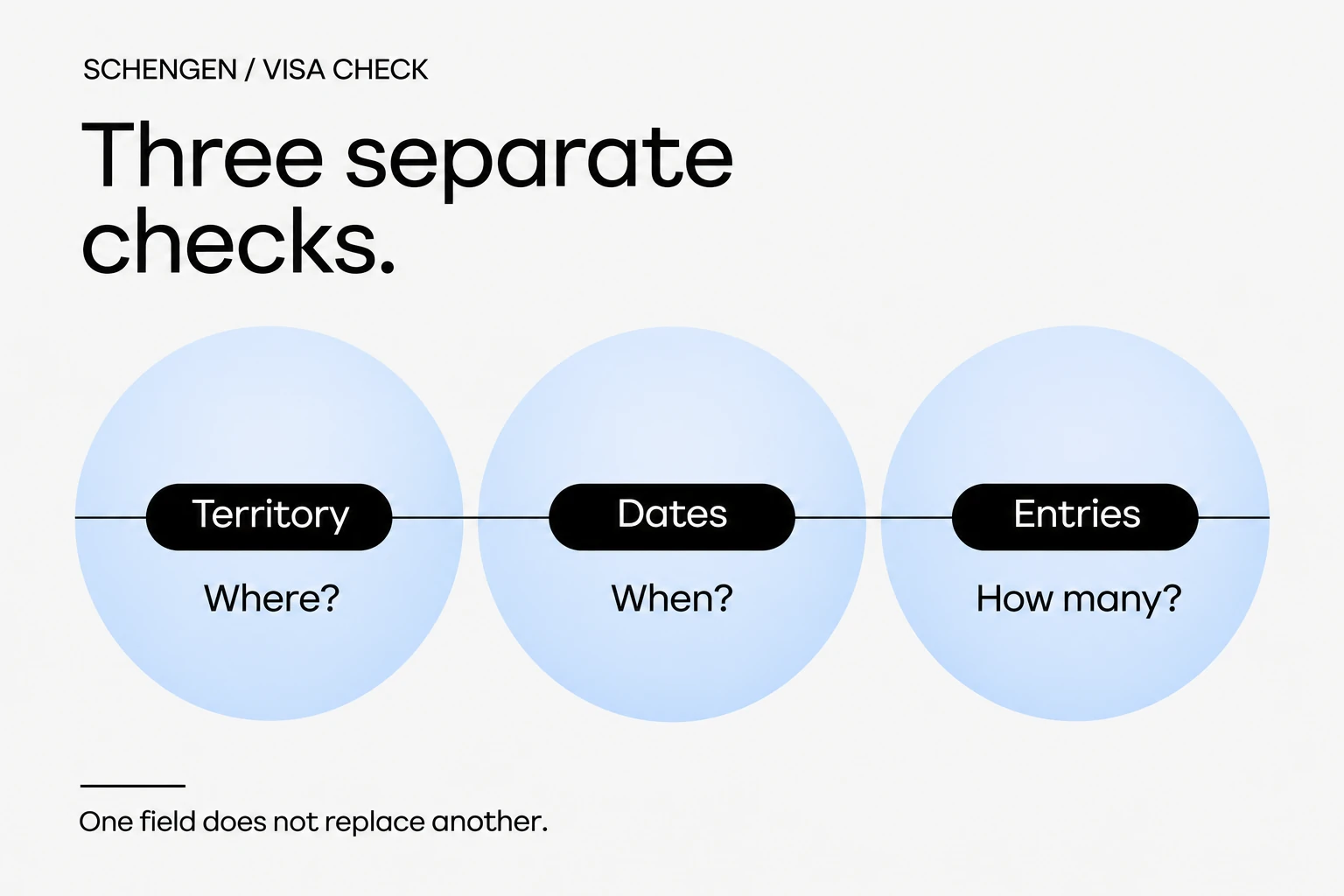
A short-stay visa’s permitted territory is separate from its entry count and dates. Our route audit shows what to check before adding another country to the itinerary.
In this guide · jump to a section
An extra stop on a European itinerary is not only a question of spare days. Before adding it, read the territory printed on the visa. A short-stay Schengen visa can contain a territorial restriction that matters even when its dates and remaining entries look sufficient.
This guide concerns the territorial field of a short-stay visa, normally marked type C. It does not provide a universal interpretation for every long-stay visa or residence document. The Netherlands' own guide treats its type-D MVV document separately; a country name on that document should not be interpreted using a simplified short-stay rule.
Four fields answer four different questions
| Visa field | Question to ask | What it does not settle |
|---|---|---|
| Valid for | Which territory is covered? | How many entries remain |
| From and until | What is the calendar validity? | How many days you can actually spend |
| Duration of stay | What stay allowance is printed? | Whether another country is included |
| Number of entries | How many entries are permitted? | Whether the itinerary fits every other condition |
The Netherlands Worldwide guide explains that the territorial field can identify the Schengen area, particular countries or exclusions shown using country codes and a minus sign. The wording may be in the issuing country's language. Do not rely on recognising only the word “Schengen.”
France-Visas describes the general area-wide use of a Schengen visa while preserving the importance of restrictions and entry conditions. That general rule is the starting point, not permission to ignore what is printed on an individual visa.
Audit the actual route
Write one line for every intended country, including a connection that requires entering the territory. Beside each line, record the relevant territorial wording, entry count and travel date. If a code or restriction is unclear, ask the issuing authority what it means before buying the additional leg.
A route audit should include the return journey as well as the outward route. People often notice a restriction when planning the main holiday but overlook a different connecting airport on the way home. Whether a connection involves entry depends on the itinerary and airport arrangements; the label “transit” alone is not an answer.
A hypothetical extra-stop decision
Suppose a traveller has a short-stay sticker that excludes country X and later finds an attractive flight involving a visit there. The fact that the visa allows multiple entries would not erase that territorial exclusion. Nor would having unused days make the new stop compatible with the restriction.
This example deliberately uses a placeholder country. It illustrates how fields interact, not a claim that a named traveller or nationality normally receives a particular restriction. We have not inspected your visa, and a photograph cropped around the expiry date would not be enough to interpret it responsibly.
The practical decision is to resolve the territorial issue first. Only then calculate the stay and check the entry count. That order can prevent paying for an itinerary whose basic country coverage has not been established.
Keep eligibility and itinerary evidence together
A visa still does not guarantee entry. Supporting evidence about the purpose and conditions of the visit may be requested. Keep the current itinerary consistent with the explanation and records you can provide; do not treat an added destination as merely a design change to a booking document.
Use our Schengen calculator for its separate day-counting task, and the official-source directory to find the relevant authority. Neither tool can widen the territory printed on a visa. This article's original contribution is the route audit, built from published government explanations rather than an individual immigration decision.
Sources and verification
- Netherlands Worldwide: information on a visanetherlandsworldwide.nlRecorded substantive check: 15 Nov 2026
The Dutch government guide explains the Valid For field, country-code exclusions, dates, duration and entries. It separately explains long-stay MVV stickers, so the short-stay territorial reading must not be applied indiscriminately to type-D residence travel.
- France-Visas: frequently asked questionsfrance-visas.gouv.frRecorded substantive check: 15 Nov 2026
France-Visas explains that a Schengen visa generally covers the Schengen area unless otherwise indicated, subject to validity and entry conditions. A visa does not remove the requirement to meet entry conditions and carry relevant supporting evidence.
These are the sources cited for this article. Last article update: 15 Nov 2026. Requirements can change and depend on your nationality and circumstances. This article is general information, not a personal eligibility assessment.
Independent, AI-assisted guidance.Read moreRead less
Use this guide to prepare, then confirm the rules with the responsible authority.
- Last verified against all cited sources
- · Automated source check by Advise Visa AI-assisted source review
- Named immigration-expert review
- Not recorded · Who produces this guide
An article update date is not a source-verification date. A source check is not a guarantee of eligibility or future accuracy.
What this guide adds: An original route-by-route audit and hypothetical excluded-country example distinguish territorial validity from entry count, dates and stay length, with an explicit short-stay scope. Our original explainers