
Finland tightens Russian short-stay entry rules: check the purpose and permit, not just the flight
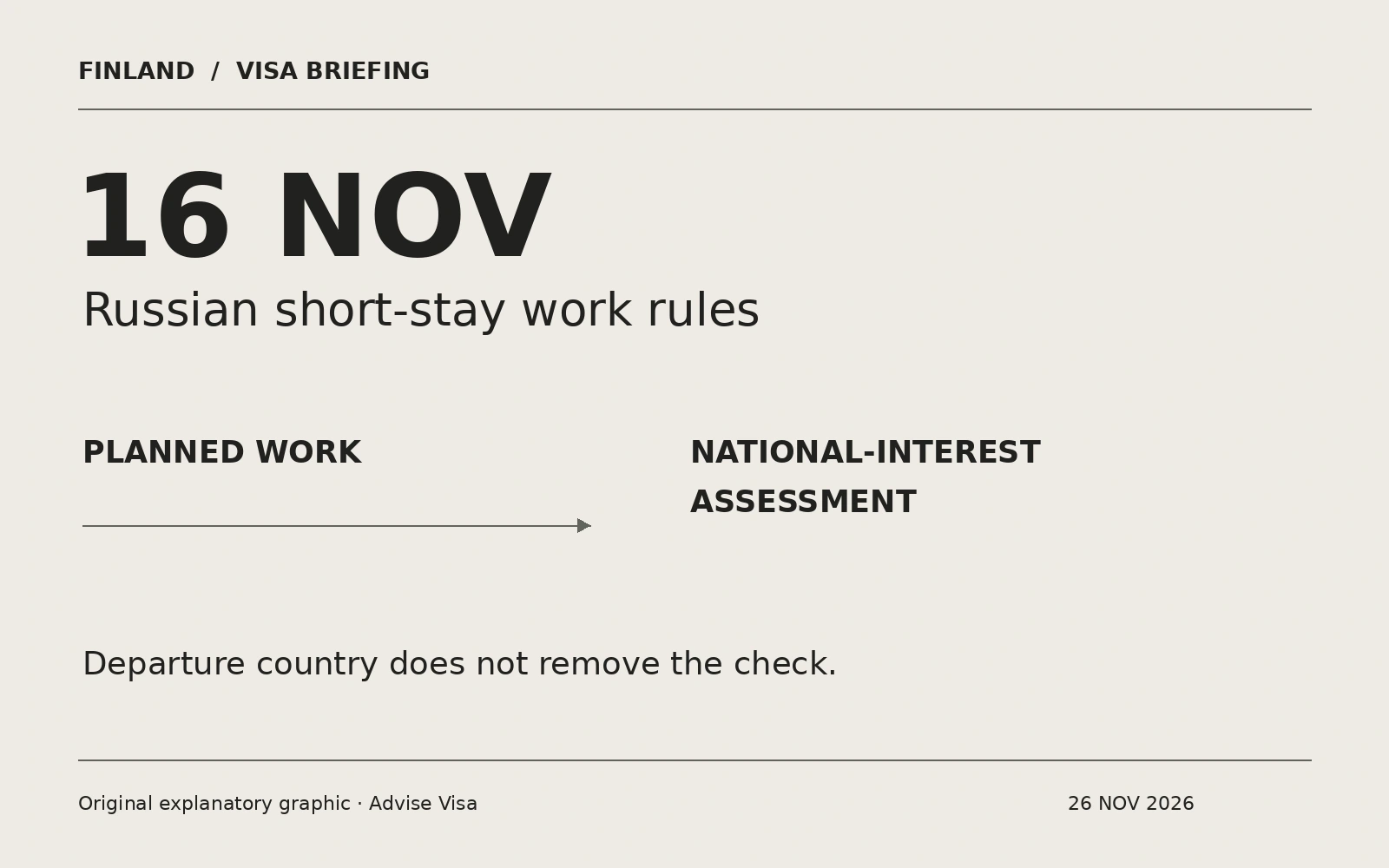
Finland tightened Russian short-stay entry rules on 16 November 2026. Check work purposes, residence-permit distinctions and evidence before arranging a trip.
In this guide · jump to a section
Finland has tightened its restrictions on short visits by Russian citizens, with the revised approach applied by authorities from 16 November 2026. People planning a work visit should check the purpose and legal basis of their stay before relying on a visa or making a booking. The change is especially relevant where a trip previously depended on the short-term work category.
A practical assessment starts with three separate facts: nationality, the document relied on for entry, and the activity in Finland. The country from which the flight departs is a fourth fact, but it does not replace the first three. This guide was checked against official Finnish information on 26 November 2026.
What Finland changed in November
The Finnish Ministry for Foreign Affairs FAQ, published through its embassy website, explains the resolution adopted on 12 November. Under the revised approach, short-term work under a Schengen visa must be considered essential to Finland's national interests. The restriction reaches beyond professional athletes to other visa-based short-term workers, including artists, seasonal workers, interpreters and experts.
It applies regardless of the departure country, including travel with a visa issued by another Schengen state. The FAQ says earlier Finnish visas are not generally being revoked simply because the resolution changed, but entry and stay remain subject to assessment. An unexpired visa is therefore not an assurance of admission.
The FAQ distinguishes entry under a short-stay visa from entry or stay under a residence permit issued by another EU or Schengen country, or a comparable national permit. It also confirms that the resolution does not remove the right to seek international protection. These distinctions matter when deciding which official guidance to consult.
Read the exception categories carefully
The ministry has published an unofficial English translation of the government resolution. Its guidelines identify ten special groups for individual consideration. They include specified family relationships, transport and logistics personnel on duty, essential business visits requiring personal presence, certain degree-related short studies, established medical treatment relationships and other special reasons.
The property category concerns property held before 30 September 2022 and essential, urgent maintenance requiring the owner's presence. The work category now requires national-interest significance, such as security of supply. These descriptions are narrower than ordinary labels such as “business”, “study” or “property owner”.
The resolution also covers non-essential transit through Finland to other Schengen states. It preserves consideration necessary for fundamental rights, humanitarian reasons, national interests and international obligations. Being potentially within a listed group calls for an assessment; the list does not convert every person using the same label into an approved traveller.
Build a purpose-based enquiry
Before contacting the Finnish authorities, write a short factual description of the proposed visit. Include the dates, destination, activity, identity of the inviting organisation and the document you intend to use. If the visit involves work, describe the actual tasks. “Consultant” or “performer” alone may conceal facts needed to assess the trip.
For a business visit, explain what must happen in person and why remote participation would not achieve it. For an urgent property problem, identify the fault, the property history and why the owner's physical attendance is necessary. These are suggested ways to make an enquiry intelligible; they are not an official document checklist or a promise that evidence will satisfy an exception.
Keep supporting material tied to the purpose being described. A general invitation saying a visitor is welcome does not explain an urgent repair or a particular technical task. Ask the host to correct incomplete factual details rather than adding dramatic language or labelling an ordinary activity “essential”. The authority, not the host or traveller, assesses the applicable conditions.
The ordinary entry requirements still need attention
Finland's official entry-requirements page says conditions are assessed on arrival. It identifies a valid passport or travel document, insurance and supporting documents. It also states that visitors must demonstrate sufficient funds, with a stated reference of EUR 50 per day, and explains how documented sponsorship and return tickets may be relevant.
The page also addresses entry bans and grounds relating to public order, security, health and international relations. These general conditions do not replace the nationality-specific assessment. A well-funded itinerary with insurance may still leave the central question about the purpose of the visit unanswered.
Organise the review in two parts: first, whether the proposed purpose can be considered under the relevant restrictions; second, whether the ordinary travel evidence is complete. This order helps avoid spending most of your preparation time on hotel confirmations while overlooking the reason admission may be restricted.
Four examples of questions to resolve before booking
The following are hypothetical planning examples. They illustrate questions to ask, rather than predicting an entry decision.
A Russian professional living in Dubai plans a short paid engagement in Helsinki. Their UAE residence and flight origin should be recorded, but the first enquiry should explain the Finnish activity and the document relied on. The useful question is how the planned work is assessed under the new rule, not whether departing from Dubai changes the visitor's nationality.
A traveller has a Schengen visa issued for a different European trip. They should not add Finland to the itinerary simply because the visa has unused days. A separate Finland-specific purpose check should come before any additional booking. Write down both the original itinerary and the proposed change so that advice is based on the actual plan.
An engineer is invited to repair equipment. The enquiry should describe what the equipment does, the problem, the time sensitivity and the engineer's role. The word “engineer” does not explain why a task might be important to national interests. A host's technical explanation is more useful than a generic recommendation letter, but cannot guarantee a favourable assessment.
A person holds an EU-country residence permit and wants to visit Finland. Start by establishing the exact type and validity of that permit. Do not copy conclusions from a visa-only example. Ask separately about the intended activity if it involves work; this article does not treat a residence permit from another country as a blanket permission to perform any job in Finland.
Avoid turning uncertain eligibility into a costly itinerary
A ticket seller, event organiser or accommodation provider may confirm that a booking is available. That is a commercial answer, not an immigration assessment. Keep those two questions separate in your planning. Where eligibility is unresolved, record what is uncertain and seek an answer through the Finnish official channel responsible for the visa or entry question.
When seeking clarification, ask one precise question at a time and attach or describe relevant evidence without omitting inconvenient facts. A concise timeline of residence, permit validity and intended travel can prevent repeated exchanges. Keep the answer with your travel records, while recognising that the final assessment depends on the circumstances presented to the authorities.
Before departure, review the live ministry guidance again. The useful final check is not merely whether a visa sticker remains valid: it is whether the purpose, document, itinerary and supporting explanation still describe the same trip that you prepared and discussed.
Sources and verification
- Finnish MFA FAQ on November restrictionsfinlandabroad.fiRecorded substantive check: 26 Nov 2026
Resolution adopted 12 November and applied 16 November 2026; tightened short-term work and departure-country scope; permit and asylum distinctions.
- Government resolution, official hosted English translationum.fiRecorded substantive check: 26 Nov 2026
Ten special groups, transit coverage and essential-work criterion; exceptions assessed individually.
- Finnish embassy entry requirementsfinlandabroad.fiRecorded substantive check: 26 Nov 2026
General arrival checks, insurance, travel evidence and funds requirement.
These are the sources cited for this article. Last article update: 26 Nov 2026. Requirements can change and depend on your nationality and circumstances. This article is general information, not a personal eligibility assessment.
Independent, AI-assisted guidance.Read moreRead less
Use this guide to prepare, then confirm the rules with the responsible authority.
- Last verified against all cited sources
- · Automated source check by AI-assisted source research
- Named immigration-expert review
- Not recorded · Who produces this guide
An article update date is not a source-verification date. A source check is not a guarantee of eligibility or future accuracy.
What this guide adds: Provides a purpose-first enquiry workflow and four hypothetical scenarios distinguishing nationality, departure country, Schengen visa and residence permit without claiming eligibility. Our original explainers


