
Flying From the Gulf to the EU With Cash: What Counts Toward €10,000?
The declaration test can include more than banknotes. Build a currency-and-valuables inventory before crossing the EU border, and keep customs rules separate from Schengen visa rules.
In this guide · jump to a section
A traveller can be below €10,000 in euro banknotes and still need to examine the EU cash-declaration requirement. Other currencies and certain covered valuables can form part of the same calculation. Counting only the notes in the wallet is therefore a poor preparation method.
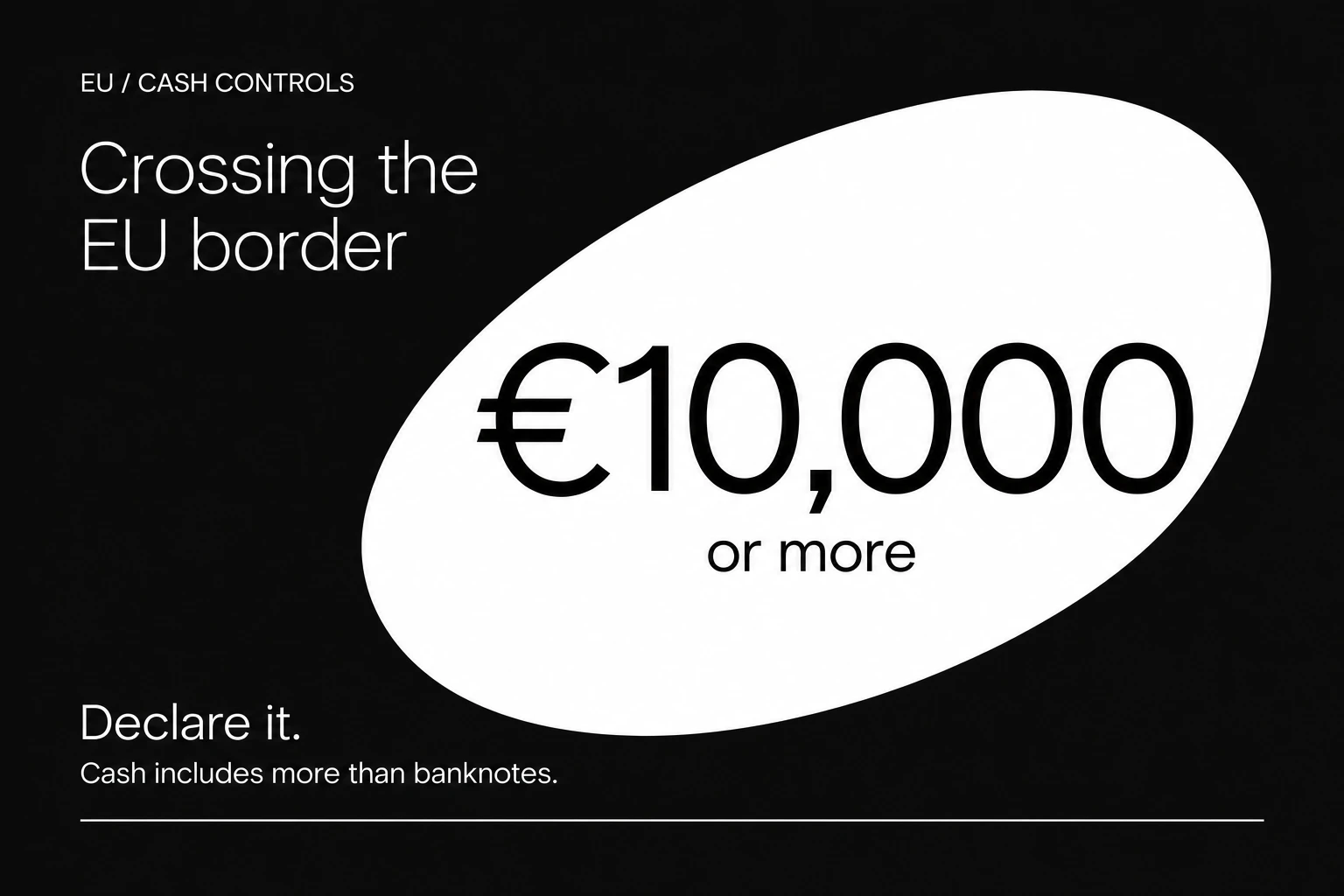
The EU threshold is €10,000 or more, or its equivalent, when entering or leaving the European Union. This article explains a preparation exercise, not an exchange-rate quotation or a decision by customs about the value of your belongings.
Start with the border, not the visa
Identify where your journey crosses the EU's external border. A Schengen visa concerns a different legal system: the EU and the Schengen area are not interchangeable geographical labels. Do not assume the place that issued your visa is the place responsible for your cash declaration.
For a multi-stop journey, write down every country and where you first enter or finally leave the EU. Then find the customs authority for the relevant crossing. Your Europe also warns that individual countries can have cash rules affecting travel between EU countries; the EU-wide external-border rule is not the whole enquiry.
Make an inventory before doing the sum
| Inventory line | Detail to record | Question to resolve |
|---|---|---|
| Banknotes and coins | Amount in each currency | Which conversion rate does customs require? |
| Covered bearer instruments | Instrument type and stated value | Is this instrument included in the legal definition? |
| Gold coins or bullion | Weight, purity and supporting records | Is it covered, and how should it be valued? |
| Money carried for another owner | Owner and purpose | What ownership information belongs on the form? |
The Commission's definition includes specified bearer instruments, gold coins containing at least 90% gold and bullion containing at least 99.5% gold. Do not extend those categories automatically to every piece of jewellery. If an item is difficult to classify, ask customs about that item rather than guessing from its appearance.
A worked calculation without a guessed exchange rate
Imagine an adult carrying €7,800 plus foreign banknotes that customs values at €2,400. The combined illustrative total is €10,200. Looking only at the euro notes would miss the threshold. These figures are invented to explain addition; they are not today's conversion of any named currency.
Create a similar calculation with your actual holdings, but leave the converted value blank until you have the relevant rate or official instruction. Record the date and basis of the calculation. If the amount is close to the threshold, a rounded estimate is a weak basis for deciding that nothing needs to be declared.
The Commission applies the obligation to each person individually and explains that an accompanying adult acts for a minor. Do not use this as a suggestion to rearrange ownership or divide funds to avoid scrutiny. Record who carries what and answer ownership questions accurately.
A declaration is part of the journey file
Keep the declaration and the records explaining the money together. A useful personal folder might contain the completed form, the inventory used to prepare it, relevant withdrawal or sale records, and the contact details of the customs office consulted. That is an organisational suggestion, not a universal list of documents every traveller must carry.
The threshold does not make suspicious movements below it immune from checks. Nor does completing a cash form resolve your visa, tax or entry position. For the next step, use the Commission's national-authority contacts and our official-source directory. Ask about your route and assets precisely, rather than asking whether “Europe allows cash.”
Sources and verification
- European Commission: EU cash controlstaxation-customs.ec.europa.euRecorded substantive check: 15 Nov 2026
The Commission states that €10,000 or more, including the equivalent in other currencies and covered instruments, must be declared when entering or leaving the EU. Covered gold includes coins with at least 90% gold and bullion with at least 99.5% gold.
- Your Europe: carrying casheuropa.euRecorded substantive check: 15 Nov 2026
The EU traveller guidance explains the border declaration requirement, the possibility of national rules between EU countries, and enforcement consequences. A customs declaration is distinct from a visa or border admission decision.
These are the sources cited for this article. Last article update: 15 Nov 2026. Requirements can change and depend on your nationality and circumstances. This article is general information, not a personal eligibility assessment.
Independent, AI-assisted guidance.Read moreRead less
Use this guide to prepare, then confirm the rules with the responsible authority.
- Last verified against all cited sources
- · Automated source check by Advise Visa AI-assisted source review
- Named immigration-expert review
- Not recorded · Who produces this guide
An article update date is not a source-verification date. A source check is not a guarantee of eligibility or future accuracy.
What this guide adds: An original mixed-currency calculation, inventory template and route audit explain how to identify the declaration question without inventing an exchange rate or a customs valuation. Our original explainers


